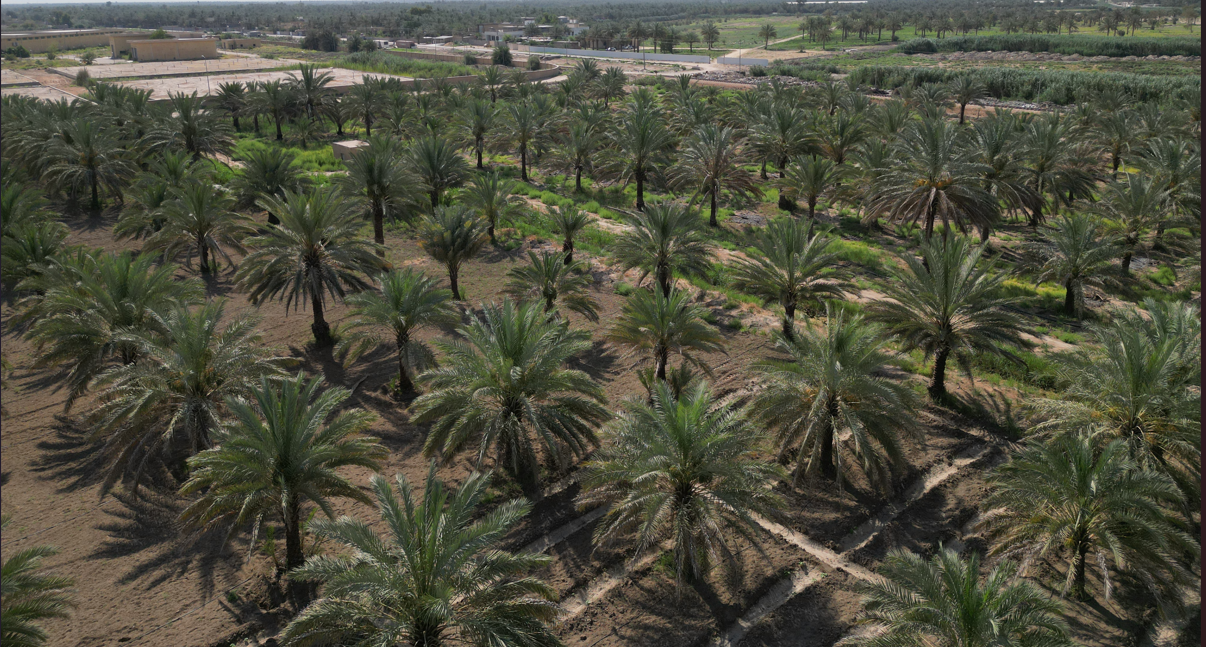
The University of Warith Al-Anbyiaa Palm Cultivation
The palm cultivation initiative reflects a long-term commitment to environmental sustainability, ecological preservation, and sustainable land management. As one of the most culturally and environmentally significant plant species in the region, date palms contribute not only to the enhancement of green landscapes but also to biodiversity conservation, climate resilience, and sustainable agricultural development. Through the cultivation of a wide range of palm varieties and the integration of environmentally responsible practices, the initiative supports research, education, biomass utilisation, and wider sustainability objectives whilst promoting a greener and more resilient environment.
Palm Cultivation and Biodiversity
The palm cultivation initiative represents an important contribution to environmental sustainability, biodiversity preservation, and scientific development. The project includes more than 90 varieties of palm trees and approximately 1,281 palm trees in total, creating a diverse ecological environment that supports sustainable land management and long-term environmental resilience.
Environmental Sustainability
Date palms play a significant role in combating desertification, improving air quality, reducing soil erosion, and enhancing green spaces in arid and semi-arid regions. Their ability to adapt to harsh climatic conditions makes them an essential component of sustainable agriculture and environmental conservation systems. Research has demonstrated that date palm ecosystems contribute to agroforestry, biodiversity conservation, and climate adaptation strategies within desert environments. In this regard, the initiative contributes to the objectives of SDG 13 (Climate Action) through supporting climate resilience and reducing environmental degradation, whilst also advancing SDG 15 (Life on Land) by promoting biodiversity conservation and sustainable land use. Furthermore, the enhancement of green infrastructure and environmental quality supports the aims of SDG 11 (Sustainable Cities and Communities).
Biomass and Waste Recycling
In addition to their environmental value, palm trees are also utilised as a source of biomass and organic waste recycling. Palm residues, including fronds, fibres, trunks, and other organic by-products, can be repurposed for biomass production, composting, renewable energy generation, and sustainable agricultural applications. The use of palm biomass supports waste reduction practices and contributes to circular sustainability approaches by transforming agricultural waste into valuable environmental and economic resources. These practices align with the objectives of SDG 12 (Responsible Consumption and Production) through encouraging sustainable resource management and waste reduction, whilst also contributing to SDG 7 (Affordable and Clean Energy) through the promotion of renewable biomass applications.
Academic and Research Benefits
The diversity of more than 90 palm varieties provides valuable opportunities for academic and scientific research. The palm cultivation areas serve as living laboratories for studies related to environmental science, sustainable agriculture, biodiversity, climate change adaptation, irrigation efficiency, biomass utilisation, and desert ecosystem management.
In addition, the large number of palm trees within the project supports student engagement, field-based learning, and interdisciplinary research activities. Researchers and students may utilise the site for practical studies involving smart agriculture technologies, biodiversity monitoring, pest management, renewable biomass applications, and environmental sustainability practices. Through promoting practical environmental education, scientific research, and innovation in sustainable agriculture, the initiative contributes to the objectives of SDG 4 (Quality Education) and SDG 9 (Industry, Innovation and Infrastructure).
Contribution to Sustainable Development
By integrating sustainable palm cultivation with biomass utilisation, environmental research, and practical education, the initiative supports a comprehensive approach to sustainable development. The cultivation and preservation of more than 90 palm varieties enhances biodiversity conservation and strengthens ecological resilience, whilst the use of palm waste for biomass and composting promotes sustainable resource management and reduces environmental waste.
The project also creates opportunities for applied research, field-based learning, and interdisciplinary collaboration in areas such as climate adaptation, sustainable agriculture, renewable energy, and environmental management. Through these activities, the initiative not only improves environmental sustainability and green infrastructure, but also contributes to advancing scientific knowledge, supporting innovation, and encouraging long-term environmental responsibility within the wider community.

Sustain
RECENT POST
-

Student Union
09 October, 2026
-

NGOs Collaboration
09 October, 2026
-

Outreach & Engagement
09 October, 2026